SEARCH

Martin D, Poole R. A case of maternally inherited diabetes and deafness. Practitioner February 2022;266(1855):23-25
A case of maternally inherited diabetes and deafness
24 Feb 2022
AUTHORS
Dr Daniel Martin BMBS BMedSci, Foundation Year 2 doctor
Dr Ruth Poole DM FRCP, Consultant in Diabetes and Endocrinology Poole Hospital, University Hospitals Dorset, Poole, Dorset, UK
Competing interests: None
Article
Maternally inherited diabetes and deafness (MIDD) is a rare form of diabetes, affecting an estimated 0.1-0.2% of patients with diabetes in the UK. It is caused by an A to G (adenine to guanine) substitution at position 3243 of the mitochondrial DNA encoding the gene for tRNA. Affected women pass the condition on to both daughters and sons. All their daughters and sons will inherit the mutation but due to phenotypic variance some will have both diabetes and deafness, some will only have deafness, some will only have diabetes and others may have no problems at all. However, affected men cannot pass the condition on to any of their offspring. It has high penetrance, with more than 85% of carriers developing diabetes during their lifetime. Diagnosis is often challenging with some patients initially assumed to have type 1 diabetes. Cases may also be misdiagnosed as type 2 diabetes depending on age and presentation. The average age at diagnosis of MIDD is approximately 37 years but can range from 11 to 68 years. Bilateral sensorineural hearing loss occurs in most cases. The hearing loss typically develops in early adulthood and often precedes the onset of diabetes. Other complications include: rapidly progressive heart failure or arrhythmias; nephropathy due to focal segmental glomerular sclerosis; proximal myopathy; macular dystrophy; and stroke.
We present the case of a 36-year-old man, diagnosed with a rare type of diabetes.
Case report
A 36-year-old man was referred to his GP from the optometrist after a routine eye examination had revealed silver wiring retinal changes.
A range of blood tests were ordered to look for autoimmune and vascular pathology. HbA1c and random glucose were 132 mmol/mol and 35.2 mmol/L respectively.
When the patient was seen by his GP, he reported feeling well in himself.
His only symptoms having been increased thirst for 2-3 weeks and mild lethargy.
He was of slim build with a BMI 19.3 kg/m2. Other examination was normal. Urine dipstick revealed +++ glucose and trace ketones.
His only past medical history of note was bilateral sensorineural hearing loss that had developed in his twenties for which he had hearing aids, and a possible diagnosis of autism spectrum disorder.
He was not on any regular medication and had no known drug allergies.
The patient was referred to the hospital diabetes service, with a presumed diagnosis of type 1 diabetes and started on a basal bolus insulin regimen.
Diagnosis
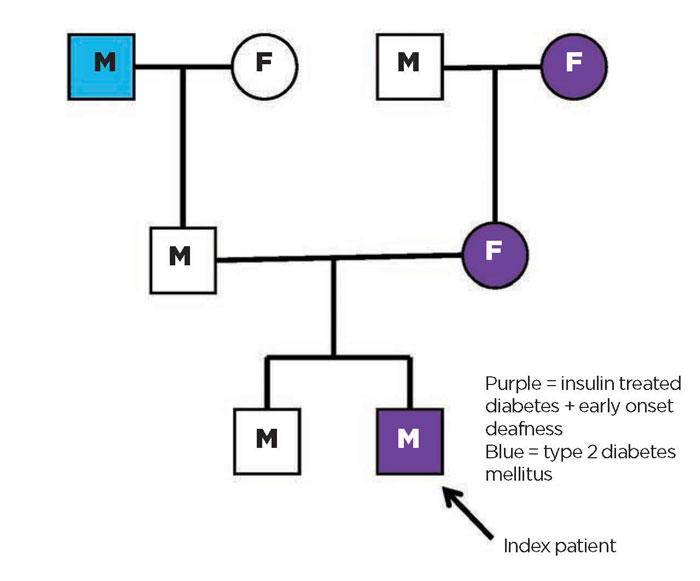
The diabetes consultant took a thorough family history. This revealed a history of insulin treated diabetes in the patient’s mother and maternal grandmother, see figure 1.
Both relatives also had a history of early onset bilateral deafness. His paternal grandfather had type 2 diabetes and ischaemic heart disease but no other history of note. There was no significant paternal or maternal history of any autoimmune conditions.
Tests for glutamic acid decarboxylase (GAD) antibodies and C-peptide were ordered given the abnormal presentation. The presence of GAD antibodies and a low C-peptide would suggest an autoimmune pathology and a reduced production of insulin and is typically seen in type 1 diabetes. However, negative antibodies do not exclude type 1 diabetes and C-peptide can be normal early in the disease.
The GAD antibodies test was weakly positive at 8IU/ml (normal < 5IU/ml). The C-peptide was 473 pmol/L which is within normal limits (350-1,800 pmol/L). So these results cast doubt on the presumptive diagnosis of type 1 diabetes.
Given the significant maternal history of diabetes and deafness it was decided to send the patient for genetic testing. The results revealed a pathogenic mutation in the MT-TL1 gene, confirming a diagnosis of maternally inherited diabetes and deafness (MIDD).
Testing was then arranged for his mother and his asymptomatic brother. Echocardiogram and 24-hour ECG were arranged for the patient.
Discussion
MIDD is a rare form of diabetes, only affecting an estimated 0.1-0.2% of patients with diabetes in the UK.1
It is caused by an A to G (adenine to guanine) substitution at position 3243 of the mitochondrial DNA encoding the gene for tRNA (see box 1).2,3
Other point mutations have been associated with the condition but are extremely rare in comparison.
A number of other gene mutations have been sequenced, associated with an increased risk of developing diabetes. One such example is a form of maturity onset diabetes of the young associated with mutations in hepatocyte nuclear factor; these mutations are associated with, in some cases, a greater than 95% chance of developing diabetes.4 MIDD has a similarly high penetrance, with more than 85% of carriers developing diabetes during their lifetime.2
MIDD is caused by mutations in mitochondrial DNA (mtDNA) and follows a maternal pattern of inheritance. During fertilisation paternal mitochondria are not retained within the oocyte and hence all mitochondrial genetic material is gained from the mother.5 This means that affected women can pass the condition on to daughters and sons.
All their daughters and sons will inherit the mutation but due to phenotypic variance some will have both diabetes and deafness, some will only have deafness, some will only have diabetes and others may have no problems at all.6 Affected men cannot pass the condition on to any of their offspring.
Diagnosis is often challenging with cases, including our case, initially assumed to have type 1 diabetes. Cases are often misdiagnosed as type 1 or type 2 diabetes mellitus depending on age and presentation, with around 8% of patients presenting with diabetic ketoacidosis.2
Average age at diagnosis of MIDD is around 37 years, however it ranges from 11 to 68 years in reported cases.6
Patients presenting with a type 2 diabetes picture can initially be treated with lifestyle modification with or without medication. However, metformin is contraindicated because of the riskof lactic acidosis, a risk perpetuated by the patient’s known mitochondrial dysfunction.5,7
Irrespective of this, evidence suggests that the majority of patients with MIDD will be insulin dependent within two years of diagnosis.6
The pathophysiology resulting in the mitochondrial mutation leading to diabetes seems to be multifactorial.
The main cause appears to reside in the pancreatic beta cells’ gradual inability to detect glucose and subsequently secrete insulin. Hepatic glucose production may also become dysregulated by the A3243G mutation, leading to hyperglycaemia from gluconeogenesis.8,9
There is evidence to suggest that increased insulin resistance does not play a major role in the development of hyperglycaemia, this may explain why many of the patients become insulin dependent in a relatively short space of time.10
Deafness
Bilateral sensorineural hearing loss occurs in most cases.1,11 A prospective European study reported deafness in 90% of their MIDD patients.12 A recent Chinese study reported hearing loss in 85% of MIDD cases.13 The hearing loss originates from the cochlea as opposed to the cranial nerve. Diagnosis is by audiography.
The hearing loss typically develops in early adulthood and often precedes the onset of diabetes.2,11 Patients tend to follow one of two courses: either rapid initial hearing loss or slow decline over years. Men are more often affected with the former and frequently have more severe symptoms.
Higher frequencies are often initially affected, with severe hearing loss in all frequencies later in life.2,14 Management involves insertion of hearing aids.
Avoidance of exacerbating factors, such as aminoglycoside antibiotics is crucial.2 It has long been recognised that aminoglycoside antibiotics can cause ototoxicity with the development of sensorineural deafness. Recent evidence has shown that the tendency to develop this complication is related to mutations in mitochondrial DNA. Thus patients with mitochondrial disease are particularly at risk.15
Other complications
Cardiac
Perhaps the most concerning feature of MIDD is the association with premature cardiac death. Rapidly progressive heart failure over a year has been described in young adults with MIDD.
Left ventricular hypertrophy is seen four times more commonly in those with MIDD.
Cardiac autonomic neuropathy is also more common compared with other types of diabetes, i.e. cardiomyopathy or arrhythmias.13
Early monitoring (at the age of 30) with baseline ECG and echocardiography with annual follow-up in high-risk individuals is advised.2,6
Renal
There is a high prevalence of end-stage renal failure in patients with MIDD.
The most common feature is not diabetic nephropathy but focal segmental glomerular sclerosis.
This commonly presents as proteinuria in young adults and is more common in females. Early treatment with ACE inhibitors is recommended.2,6
Myopathy
Clinical myopathy in MIDD generally involves proximal limb muscles (shoulders, buttocks and thighs). Symptoms generally manifest as exercise-induced muscle cramps or weakness. Symptoms are present in up to 40% of cases.6
Macular dystrophy
MIDD can be associated with a maculopathy in 50-85% of patients.
This presents as either a bilateral macular pattern or retinal pigment epithelium atrophy, hence is often misdiagnosed as age-related or a separate macular pathology. Symptoms include: photophobia, black spots and eventual visual loss.16
Stroke
In young adults with MIDD (< 45 years) stroke occurs in approximately 1% of cases.6
Gastrointestinal complaints
Patients with MIDD often complain of gastrointestinal upset, this usually manifests as constipation.2,6
Conclusion
We have presented an unusual case of diabetes, highlighting that rarer forms
of diabetes need to be considered when confirming diagnosis.
Management may differ, for example the use of sulphonylureas in patients with maturity onset diabetes of the young or the avoidance of metformin in MIDD.
Furthermore, some monogenic forms of diabetes have other complications that need to be screened for in addition to the standard screening tests performed in more common types of diabetes.
This case report also highlights the need to take a thorough family history as with MIDD the clue to diagnosis is in its pattern of inheritance and thorough history taking will often lead to earlier diagnosis and management.
Given the potential implications of the diagnosis it is important that clinicians can answer questions from families about inheritance and genetic testing.
In this case the inheritance pattern could have been autosomal dominant or maternally inherited. However, the associated history of deafness in the patient and his affected relatives pointed towards MIDD rather than other forms of monogenic diabetes.
The presence of what seemed at first to be an unrelated past medical history was a vital clue to the final diagnosis.
REFERENCES
1 Guillausseau PJ, Massin P, Dubois-La Forgue D et al. Maternally inherited diabetes and deafness: a multicenter study. Ann Intern Med 2001;134(9 Part 1):721-28
2 Murphy R, Turnbull DM, Walker M, Hattersley AT. Clinical features, diagnosis and management of maternally inherited diabetes and deafness (MIDD) associated with the 3243A> G mitochondrial point mutation. Diabet Med 2008;25(4):383-99
3 Van den Ouweland JM, Lemkes HH, Ruitenbeek W et al. Mutation in mitochondrial tRNA Leu (UUR) gene in a large pedigree with maternally transmitted type II diabetes mellitus and deafness. Nature Gen 1992;1(5):368-71
4 Stride A, Hattersley AT. Different genes, different diabetes: lessons from maturity-onset diabetes of the young. Ann Med 2002;34(3):207-16
5 Maassen JA. Mitochondrial diabetes: pathophysiology, clinical presentation, and genetic analysis. Am J Med Genet 2002;115(1):66-70
6 www.diabetesgenes.org/what-is-mody/maternally-inherited-diabetes-deafness-midd/ [Last accessed 8 Dec 2021]
7 Lalau JD. Lactic acidosis induced by metformin. Drug Safety 2010;33(9):727-40
8 Maassen JA, M‘t Hart L, Van Essen E et al. Mitochondrial diabetes: molecular mechanisms and clinical presentation. Diabetes 2004;53(Suppl 1):S103-09
9 Maassen JA, Janssen GM, Hart LM. Molecular mechanisms of mitochondrial diabetes (MIDD). Ann Med 2005;37(3):213-21
10 Walker M, Taylor R, Stewart M et al. Insulin sensitivity and mitochondrial gene mutation. Diabetes Care 1995;18:273-75
11 Reardon W, Pembrey ME, Trembath RC et al. Diabetes mellitus associated with a pathogenic point mutation in mitochondrial DNA. Lancet 1992;340(8832):1376-79
12 Laloi-Michelin M, Meas T, Ambronville C et al Mitochondrial Diabetes French Study Group. The clinical variability of maternally inherited diabetes and deafness is associated with the degree of heteroplasmy in blood leukocytes. J Clin Endocrinol Metabol 2009;94:3025-30
13 Yang M, Xu L, Xu C et al. The mutations and clinical variability in maternally inherited diabetes and deafness: an analysis of 161 patients. Front Endocrinol 2021;12:728043
14 Uimonen S, Moilanen JS, Sorri M et al. Hearing impairment in patients with 3243A→ G mtDNA mutation: phenotype and rate of progression. Hum Genet 2001;108(4):284-89
15 Fu X, Wan P, Li P et al. Mechanism and prevention of ototoxicity induced by aminoglycosides. Front Cell Neurosci 2021;15:692762
16 Müller PL, Treis T, Pfau M et al. Progression of retinopathy secondary to maternally inherited diabetes and deafness – evaluation of predicting parameters. Am J Ophthalmol 2020;213:134-44
ARTICLE IN PDF
 Download this article in PDF format
EXTERNAL WEBLINKS
For healthcare professionals
Diabetes Genes
www.diabetesgenes.org/what-is-mody/maternally-inherited-diabetes-deafness-midd